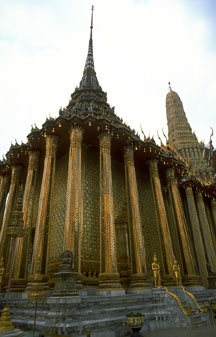
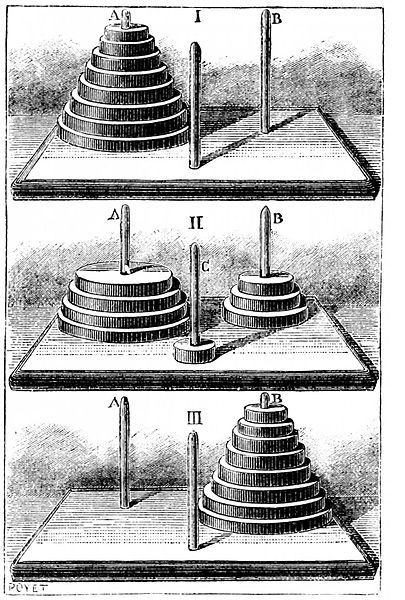
An old legend tells of a Hindu temple where the pyramid puzzle might have been used for the mental discipline of young priests. The legend says that at the beginning of time, the priests in the temple were given a stack of 64 gold disks, each one a little smaller than the one beneath it. Their assignment was to transfer the 64 disks from one of three poles to another, with one important rule: a large disk can never be placed on top of a smaller one. The priests worked very efficiently, day and night. When they finished their work, the myth said, the temple would crumble into dust, and the world would vanish.
In 1883, Edouard Lucas, a French mathematician, invented a game called the Tower of Hanoi (sometimes referred to as the Tower of Brahma or the End of the World Puzzle). The game begins with a number, for example of 3 discs, arranged on one of three poles. Each disc is smaller than the disc below it. The object is to move all the discs from the starting tower to one of the remaining towers. Only one disc can be moved at a time, and a larger disc can never be placed on top of a smaller one. Use the lowest number of possible moves.
|
Using the supplied plastic cups to simulate the discs, with number 7 indicating the largest size and 1 the smallest, do the following activities.
|
|
Source (text, image 1) from TBS Teachers
Source (image 2) from Wikimeida Commons
